


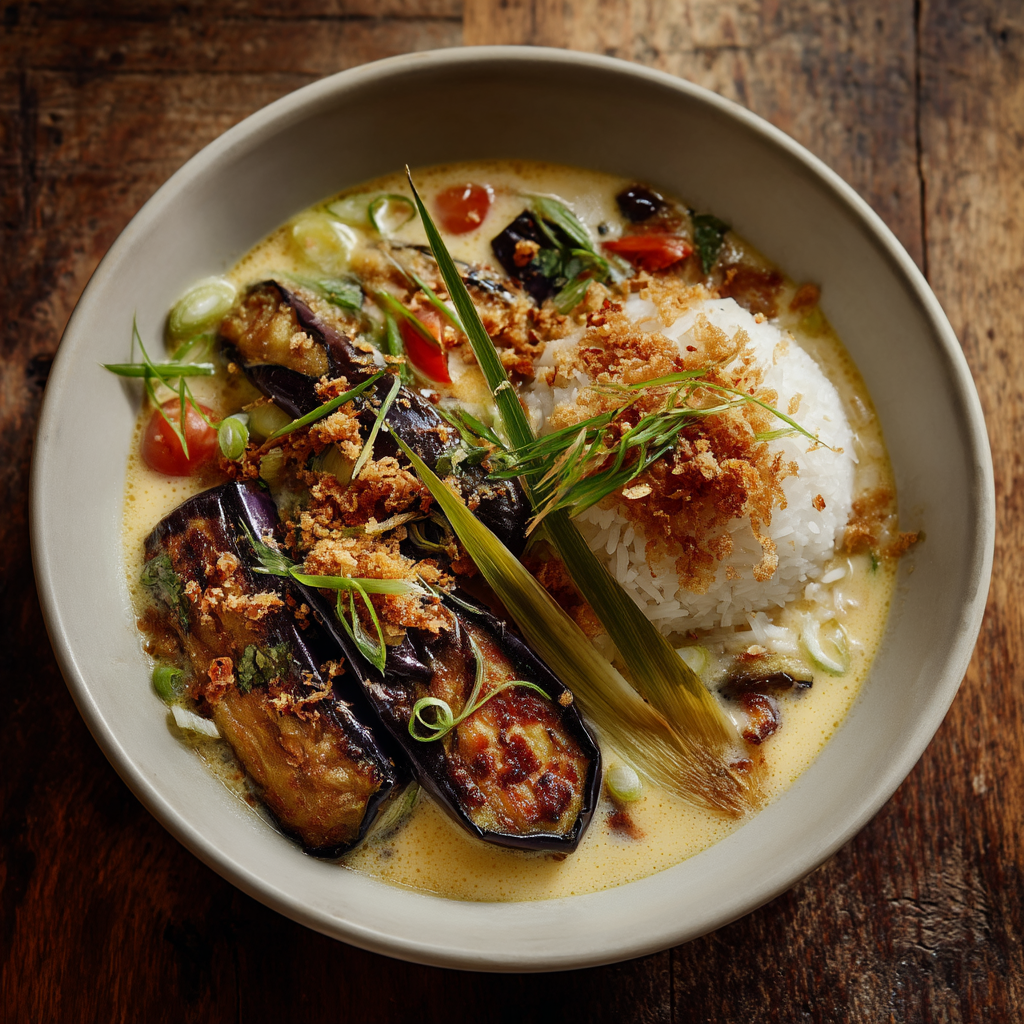
Filipino vegetarian dinner: Charred Eggplant Coconut-Sour Braise with Banana Blossom and Garlic Rice Crumble
Recipe Overview
Dish Name: Charred Eggplant Coconut-Sour Braise with Banana Blossom, Long Beans, and Garlic Rice Crumble
Cuisine: Tagalog | Category: Vegetarian Course | Serves: 4
Prep Time: 20 minutes | Cook Time: 30 minutes | Total Time: 50 minutes
Why This Works
Forget the tired “veganized classic” routine. You want Tagalog flavor, vegetarian, and satisfying enough for dinner, not a side dish cosplay. This hits that mark by leaning on what actually makes the food taste Filipino: a proper gisa base (garlic, onion, tomato), coconut richness, and controlled acidity. The eggplant gets charred hard for bitterness and smoke, not because it looks cool on Instagram. Banana blossom brings a clean, gentle astringency that keeps the coconut from turning into beige sludge. The garlic rice crumble does one job: make every bite feel alive. If you can sauté without burning garlic and you understand simmer means simmer, you can execute this cleanly.
Ingredients (Serves 4)
For the charred eggplant:
- 600 g eggplant (2 medium), sliced lengthwise into 2 cm planks
- 30 ml neutral oil
- Fine salt
For the Tagalog gisa base and coconut milk vegetable braise:
- 45 ml neutral oil
- 200 g onion (1 large), thinly sliced
- 20 g garlic (6 cloves), minced
- 25 g ginger (1 thumb), cut into fine matchsticks
- 250 g tomatoes (2 medium), chopped
- 2 bay leaves
- 400 ml coconut milk
- 200 ml water, plus more as needed
- 30 ml cane vinegar (or white vinegar)
- 25 ml calamansi juice (or 20 ml lime plus 5 ml lemon)
- 10 ml soy sauce (optional but recommended for umami without fish sauce)
- 8 g brown sugar (2 tsp)
- 250 g banana blossom (puso ng saging), sliced thin
- 200 g long beans (sitaw) or green beans, cut into 5 cm lengths
- Black pepper, aggressive amount
- Salt to taste
For the garlic rice crumble:
- 200 g cooked rice (about 1 packed cup), ideally day-old and cold
- 30 ml neutral oil
- 10 g garlic (3 cloves), finely chopped
- 20 g toasted coconut flakes (optional), or leave it pure rice-and-garlic
- Salt
To finish:
- Spring onions, sliced
- Extra calamansi or lime wedges
Method
Mise en Place (20 minutes)
Tools: large heavy pan or cast-iron skillet, wide pot with lid, cutting board, sharp knife, wooden spoon, sheet tray.
- Slice eggplant into planks. Salt lightly and leave it while you cut everything else. You are not “drawing out bitterness.” You are seasoning early so it tastes like something.
- Slice onion, mince garlic, chop tomatoes, cut ginger, prep beans, slice banana blossom.
- Break cold rice into loose grains. Clumps are the enemy if you want crunch.
Char the Eggplant (10 minutes)
Get the pan properly hot. Oil the eggplant lightly, not the pan. Lay the planks down and do not fuss with them. You want deep browning and some blackened edges. That char is your bitterness and smoke, which is what keeps coconut milk from tasting flat. Pull to a tray.
Build the Gisa Base (8 minutes)
Lower the heat to medium. Add oil, then onion with a pinch of salt. Cook until softened and translucent. Add garlic and ginger and stir for 30 to 45 seconds, just until fragrant. Add tomatoes and cook until they collapse into a jammy paste. If your tomatoes are watery, cook longer. You are building concentration.
Coconut-Sour Braise (12 minutes)
Add coconut milk, water, bay leaves, brown sugar, soy sauce (if using), and a serious grind of black pepper. Bring to a gentle simmer.
Add vinegar first and simmer 2 minutes. Vinegar needs heat time to stop tasting raw. Then add banana blossom and simmer 6 minutes. Add long beans and simmer 4 minutes. Adjust with a splash of water if the pot looks tight; this is a braise, not a paste.
Finish with Citrus (2 minutes)
Turn off the heat. Nestle the charred eggplant into the braise and spoon liquid over it. Now add calamansi (or lime-lemon blend). Citrus goes in last so it stays bright instead of turning dull and bitter.
Garlic Rice Crumble (8 minutes)
In a pan, heat oil over medium. Add garlic and cook until pale gold, not brown. Add rice, toss, then press it into the pan in a thin layer. Let it sit until it crisps, then break it up and repeat until you have dry, crunchy bits. Salt it. Add toasted coconut flakes if using.
Serve (2 minutes)
Spoon braise into bowls. Shower with garlic rice crumble and spring onions. Serve with extra citrus. This is dinner.
What You Need to Know
- What to cook for a Filipino vegetarian dinner: Start with gisa, then choose one richness (coconut) and one sharpener (vinegar plus citrus). That framework delivers Tagalog flavors vegetarian cooks can lean on without borrowing fish sauce as a crutch.
- How to make Filipino flavors without fish sauce: Use black pepper, browned aromatics, and a measured hit of soy sauce, or skip soy and rely on deeper tomato reduction and heavier charring on the eggplant. The non-negotiable is a strong gisa.
- Common failures and fixes:
- Too oily: You used thick coconut milk and high heat. Simmer gently and thin with water.
- Flat and sweet: Not enough acid. Add a squeeze of citrus at the table, not more sugar.
- Bitter: You burned garlic or boiled citrus. Keep garlic pale gold and citrus off the heat.
Make-ahead: The braise holds well for 48 hours refrigerated. The crumble does not. Make the crumble fresh or it goes from crisp to sad.
The Result
First bite should hit in layers: smoky eggplant, coconut richness, sharp vinegar backbone, then a clean citrus lift that makes you want the next mouthful. The banana blossom adds tension, the beans add snap, and the rice crumble gives the whole thing a pulse. If you nailed it, the bowl tastes rich but not heavy, bright but not sour, and every spoonful has crunch.
Nutrition Information Based on a 2,000 Calorie Diet(Per Serving)
Values are estimates and will vary with coconut milk fat level, rice quantity, and oil absorption.
| Nutrient | Amount | % Daily Value |
|---|---|---|
| Calories | ~520 kcal | 26% |
| Total Fat | ~32 g | 41% |
| Saturated Fat | ~22 g | 110% |
| Cholesterol | 0 mg | 0% |
| Sodium | ~520 mg | 23% |
| Total Carbohydrate | ~52 g | 19% |
| Dietary Fiber | ~10 g | 36% |
| Total Sugars | ~12 g | N/A |
| Protein | ~9 g | 18% |
| Vitamin C | ~35 mg | 39% |
| Iron | ~4 mg | 22% |
| Potassium | ~900 mg | 19% |
Flavor Balance
Sweet (3/10): tomato sweetness and a small dose of brown sugar keep the edges rounded
Salty (4/10): salt plus optional soy sauce, backed by the natural salinity of reduced aromatics
Sour (7/10): vinegar backbone with citrus lift added off heat for precision
Bitter (4/10): eggplant char and bay leaf give structure, not harshness
Umami (6/10): gisa concentration, optional soy sauce, and browned surfaces deliver depth
Wine Pairing
1. Technical Match
- Weight: Medium dish body, medium wine body works best. Coconut adds weight; keep the wine clean.
- Acid Balance: High acidity is mandatory. You have vinegar and calamansi, so the wine needs lift, not softness.
- Tannin Interaction: Minimal tannin. Coconut fat plus tannin equals chalky misery.
- Serving Temperature: 8 to 10°C. Cold enough to stay sharp, warm enough to show texture.
2. Flavor Architecture
- Primary Bridge: Citrus and pith. The dish finishes on calamansi; the wine should echo that.
- Complementary Elements: Mineral, herbal, or saline notes cut through coconut richness.
- Regional Logic: Australian white wines built around acid and texture are made for this kind of food.
- Common Mistakes: Oaky Chardonnay and big tropical Sauvignon Blanc. Oak fights the sour edge; loud fruit makes the dish taste metallic.
3. Recommendations with Scoring
Primary Pairing: Eden Valley Riesling (Australia)
- Intensity Match: 9/10
- Flavor Harmony: 9/10
- Texture Interaction: 8/10
- Why: Riesling brings lime, acidity, and a clean finish that lifts coconut and doesn’t flinch at vinegar. Eden and Clare styles are built for precision, not flab. Pewsey Vale is a reliable reference point for Eden Valley Riesling.
- Specific Producers: Pewsey Vale (Eden Valley) , Grosset Polish Hill (Clare Valley)
Alternative 1: McLaren Vale Fiano (Australia)
- Intensity Match: 8/10
- Flavor Harmony: 8/10
- Texture Interaction: 9/10
- Why: Fiano has texture and often a preserved-lemon, nutty edge that mirrors the garlic rice crumble while staying bright enough for the citrus finish. Oliver’s Taranga is a widely available example.
- Specific Producers: Oliver’s Taranga (McLaren Vale)
Alternative 2: Dry Pinot Gris, Mornington Peninsula (Australia)
- Intensity Match: 8/10
- Flavor Harmony: 7/10
- Texture Interaction: 8/10
- Why: When kept dry and restrained, Pinot Gris brings pear and citrus pith with enough phenolic grip to stand up to char and coconut, without tannin problems. Kooyong Beurrot is a good example.
- Specific Producers: Kooyong Beurrot (Mornington Peninsula)
HACCP-Compliant Storage and Safety
Cooling
- Cool leftovers from 60°C to 21°C within 2 hours, then from 21°C to 5°C within 4 hours.
- Portion into shallow containers before refrigerating to speed cooling.
- Do not leave coconut-based dishes at room temperature longer than 2 hours total.
Refrigeration
- Store at 5°C or below.
- Maximum holding time: 3 days refrigerated.
- Keep rice crumble separate; it is best made fresh, but if stored, keep airtight and dry for up to 24 hours.
Freezing
- Freeze braise only (not the crumble) at -18°C or below.
- Maximum holding time: 2 months.
- Thaw in the refrigerator (5°C or below), not on the counter.
Reheating
- Reheat braise to 75°C throughout (check the center of the container if reheating a batch).
- Reheat once only. Repeated heat cycles ruin texture and increase risk.
- Add fresh citrus after reheating, not before.
Disposal
- Discard if held above 5°C for more than 2 hours.
- Discard refrigerated leftovers after 3 days.
- Discard any leftovers with off smell, visible mold, or sourness that is not clearly from added acid.
