


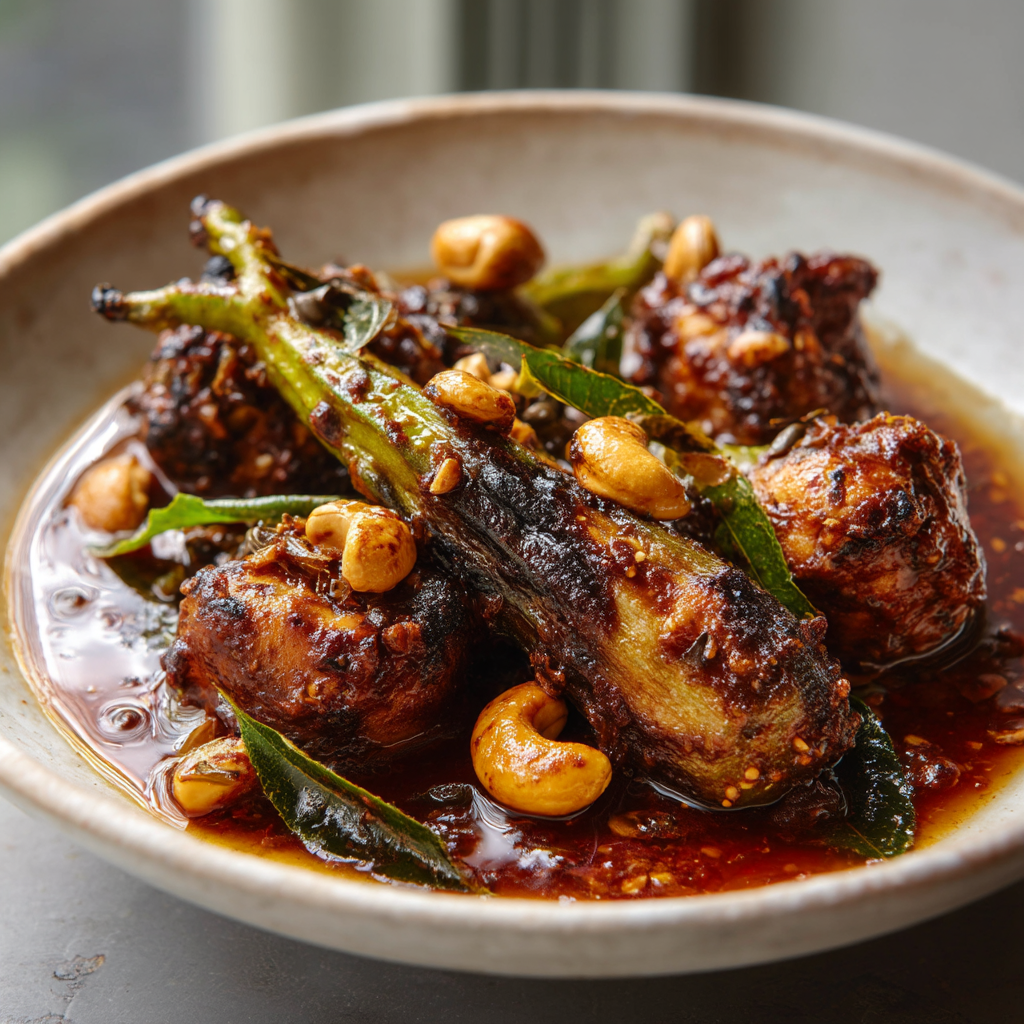
Charred Drumstick Pods in Tamarind-Coconut Reduction: A South Indian Vegetarian Dinner
Recipe Overview
Dish Name: Charred Drumstick Pods in Tamarind-Coconut Reduction with Tempered Cashews and Curry Leaf Oil Cuisine: South Indian | Category: Vegetarian Course | Serves: 4 Prep Time: 20 minutes | Cook Time: 35 minutes | Total Time: 55 minutes
Why This Works
This South Indian vegetarian dinner solves the eternal problem of vegetable mains that feel like compromise. Drumstick pods (moringa) get the high-heat treatment they deserve, developing a char that brings out their natural sweetness and creates textural contrast against their fibrous interior. The tamarind-coconut reduction isn’t a traditional sambar or aviyal. It’s something between the two, reduced to coating consistency so it clings to the vegetables rather than drowning them. The tempered cashews add richness without cream, and the curry leaf oil brings aromatic punch without muddying the sauce. This is vegetarian food that doesn’t apologize for being vegetarian.
Ingredients (Serves 4)
For the Drumstick Preparation:
- 600g fresh drumstick pods (moringa), cut into 8cm lengths
- 15ml coconut oil
- 3g Kashmiri chili powder
- 2g sea salt
For the Tamarind-Coconut Reduction:
- 40g tamarind paste
- 200ml coconut milk (full-fat, not light)
- 150ml vegetable stock
- 2 medium tomatoes (about 200g), roughly chopped
- 3 shallots (about 90g), sliced thin
- 4 green chilies, slit lengthwise
- 10g jaggery or palm sugar
- 5g ground coriander
- 3g ground cumin
- 2g turmeric powder
- 1g fenugreek seeds
- Salt to taste
For the Tempering:
- 30ml coconut oil
- 1 teaspoon black mustard seeds
- 1 teaspoon cumin seeds
- 60g raw cashews, roughly chopped
- 2 dried red chilies, broken
- 8 fresh curry leaves
For the Curry Leaf Oil:
- 40ml coconut oil
- 20 fresh curry leaves
- 2g black peppercorns, crushed
For Serving:
- Steamed rice or dosa (not included in recipe)
- Fresh curry leaves for garnish
Method
Mise en Place (20 minutes)
Get your drumstick pods cut and keep them dry. No washing just before charring or you’ll steam them instead. Measure your spices into small bowls. Have your tamarind paste ready in warm water if it’s particularly thick. Chop cashews roughly so they have irregular edges that will catch the tempering oil. Pick your curry leaves from stems and keep separate batches for the tempering and the finishing oil. Have everything within arm’s reach before you start cooking. This recipe moves quickly once you begin.
Char the Drumsticks (8 minutes)
Heat a large cast iron skillet or heavy-bottomed pan over high heat until it’s properly hot, about 3 minutes. Toss the drumstick pieces with coconut oil, chili powder, and salt. When the pan is smoking slightly, add the drumsticks in a single layer. Don’t move them for 3 minutes. You want dark char marks, almost black in spots. Flip each piece and char the other side for another 3 minutes. The pods should be partially cooked but still firm. Remove and set aside.
Build the Sauce Base (12 minutes)
In the same pan, reduce heat to medium and add the sliced shallots. Cook for 4 minutes until they’re softened and starting to brown at the edges. Add the fenugreek seeds and let them crackle for 30 seconds. Add tomatoes, green chilies, ground coriander, cumin, and turmeric. Cook down for 5 minutes until the tomatoes have broken down completely and the oil starts to separate from the masala. You’ll see it pooling at the edges. This is your flavor foundation.
Create the Reduction (15 minutes)
Add the tamarind paste and vegetable stock to the masala base. Stir well to incorporate everything. Bring to a vigorous simmer and cook for 5 minutes to let the tamarind’s sourness mellow. Add the coconut milk and jaggery. Reduce heat to medium-low and simmer for 8 minutes, stirring occasionally. The sauce should reduce by about one-third and coat the back of a spoon. Taste and adjust salt. It should be intensely flavored because it’s a reduction, not a curry you’ll eat with a spoon.
Return the Drumsticks (5 minutes)
Nestle the charred drumstick pieces into the reduction. Spoon sauce over them and let everything simmer together for 5 minutes. The pods will finish cooking through and absorb some of the sauce while contributing their own subtle flavor. Don’t overcook or they’ll turn mushy.
Execute the Tempering (3 minutes)
In a small pan, heat 30ml coconut oil over medium-high heat. Add mustard seeds and let them pop aggressively for 20 seconds. Add cumin seeds, then immediately add the cashews. Stir constantly for 90 seconds until the cashews turn golden brown. Add the dried red chilies and curry leaves. They’ll sputter and crisp. After 30 seconds, pour this entire tempering over the drumsticks and sauce. Don’t stir yet.
Finish with Curry Leaf Oil (2 minutes)
In that same small pan (no need to wash), heat 40ml coconut oil over medium heat. Add the remaining curry leaves and crushed black peppercorns. Let them sizzle gently for 90 seconds until the curry leaves are crispy but still green. The oil will turn aromatic and slightly green. Drizzle this over the entire dish just before serving.
What You Need to Know
The char on the drumsticks is not negotiable. That’s where the complexity comes from in what would otherwise be a straightforward vegetable curry. If you can’t find drumstick pods, use thick asparagus spears or halved Japanese eggplant, but maintain that high-heat char step.
The reduction consistency matters. Too thin and it’s just another curry. Too thick and it becomes cloying. You want it to coat the vegetables like a glaze but still flow slightly when you tilt the pan. If you’ve gone too far, add a splash of stock. If it’s too thin, give it another 3-4 minutes of reduction.
Make the curry leaf oil last. Those leaves burn quickly and lose their aromatic punch if they sit too long. The black pepper in the oil adds a different heat than the green chilies in the sauce, creating layered spice that develops as you eat.
The Result
You get drumstick pods with caramelized, slightly bitter char marks softened by a sauce that’s simultaneously rich, sour, and subtly sweet. The cashews provide textural surprise and carry the tempered spices. Each bite delivers multiple layers: the char, the coating sauce, the crunch of cashew, and finally the aromatic hit of curry leaf oil and black pepper. The drumstick itself has a unique texture when you scrape the tender flesh from the fibrous pod. This is how you serve a South Indian vegetarian dinner that makes people forget to ask where the protein is.
Nutrition Information Based on a 2,000 Calorie Diet (Per Serving)
| Nutrient | Amount | % Daily Value |
|---|---|---|
| Calories | 385 kcal | 19% |
| Total Fat | 32g | 41% |
| Saturated Fat | 22g | 110% |
| Trans Fat | 0g | 0% |
| Cholesterol | 0mg | 0% |
| Sodium | 485mg | 21% |
| Total Carbohydrate | 24g | 9% |
| Dietary Fiber | 6g | 21% |
| Total Sugars | 9g | – |
| Protein | 8g | 16% |
| Vitamin D | 0mcg | 0% |
| Calcium | 98mg | 8% |
| Iron | 3.2mg | 18% |
| Potassium | 625mg | 13% |
| Vitamin A | 142mcg | 16% |
| Vitamin C | 88mg | 98% |
Flavor Balance
Sweet (5/10): Jaggery and coconut milk provide baseline sweetness that balances the tamarind’s acidity. The charred drumstick pods contribute caramelized sugars from the Maillard reaction. This isn’t a sweet dish, but the sweetness rounds out the sharp edges.
Salty (6/10): Controlled salinity from the initial seasoning and adjusted in the reduction. The tempered cashews carry salt crystals that provide textural bursts. Coconut milk’s natural sodium adds background salinity without pushing the dish into oversalted territory.
Sour (7/10): Tamarind drives this dimension hard, mellowed by cooking but still assertive. Fresh tomatoes add bright acidity that contrasts with tamarind’s deeper, more complex sourness. This is the dominant flavor pillar.
Bitter (4/10): The char on the drumsticks, fenugreek seeds, and turmeric contribute measured bitterness. Curry leaves add aromatic bitterness when crisped. It’s present but supporting, not competing with the sour notes.
Umami (6/10): Tomatoes provide glutamates, cashews add depth, and the long reduction concentrates savory compounds. The vegetable stock contributes background umami. Coconut milk adds subtle umami through its amino acids. For a vegetarian dish, the umami presence is substantial.
Wine Pairing
1. Technical Match
Weight: This dish sits at medium-plus body. The coconut milk and cashews create richness, but it’s not heavy. You need a wine with enough presence to stand up to the reduction’s intensity without overwhelming the delicate drumstick pods.
Acid Balance: High acidity from tamarind demands a wine with equally high acid to avoid tasting flabby. The tomatoes compound this requirement. A low-acid wine will taste sweet and unbalanced against this sauce. You need crisp acidity that can cut through the coconut fat and match the tamarind’s tartness.
Tannin Interaction: Minimal protein and fat means high tannins will taste harsh and astringent. The coconut milk provides some fat to soften tannins, but not enough for a heavily tannic red. If going red, choose low-tannin varieties or ensure significant fruit-forward character.
Serving Temperature: 8-10°C for whites, 14-16°C for reds. The spice level and coconut richness both benefit from slightly chilled wines that refresh the palate between bites.
2. Flavor Architecture
Primary Bridge: Aromatic compounds link curry leaves and certain aromatic white varieties. The green, herbal notes in both create natural harmony. For reds, fruit-forward characteristics bridge with the jaggery’s caramel notes and tomato sweetness.
Complementary Elements: The wine’s fruit sweetness should contrast with the tamarind’s sourness while complementing the jaggery. Mineral or stone-fruit characteristics can highlight the drumstick’s subtle vegetal flavor. Slight residual sugar in off-dry whites can tame the chili heat.
Regional Logic: South Indian cuisine traditionally lacks wine culture, so there’s no “authentic” pairing. However, the coconut-tamarind combination works with wines that handle both richness and acidity, common in coastal wine regions.
Common Mistakes: Avoid oaky Chardonnays that will clash with the tempering spices. Skip high-alcohol wines that amplify chili heat. Don’t pair with heavy Shiraz that will bulldoze the delicate drumstick flavor. Avoid bone-dry wines that accentuate the tamarind’s sourness unpleasantly.
3. Recommendations with Scoring
Primary Pairing: Australian Riesling (Clare Valley or Eden Valley)
- Intensity Match: 8/10
- Flavor Harmony: 9/10
- Texture Interaction: 8/10
Why: Clare Valley Riesling’s razor-sharp acidity matches the tamarind blow-for-blow while its citrus and lime notes amplify rather than fight the dish’s sour profile. The slight petrol character in aged Rieslings echoes the curry leaf’s aromatic intensity. Off-dry versions (8-12g/L residual sugar) provide just enough sweetness to balance the green chili heat without making the pairing cloying. The wine’s mineral backbone cuts through coconut richness, refreshing your palate for the next bite. Riesling’s natural affinity for Asian spice profiles extends perfectly to South Indian cuisine.
Specific Producers: Grosset Polish Hill, Pewsey Vale Prima, Jim Barry Watervale
Alternative 1: Australian Gewürztraminer (Adelaide Hills)
- Intensity Match: 7/10
- Flavor Harmony: 8/10
- Texture Interaction: 7/10
Why: Gewürztraminer’s lychee and rose petal aromatics create an unexpected bridge with curry leaf’s floral-herbal character. The variety’s naturally lower acidity (compared to Riesling) is still adequate for this dish, and the slightly oily texture coats the palate against chili heat. The spice notes in the wine (ginger, white pepper) harmonize with the tempering spices rather than competing. Choose off-dry styles with 15-20g/L residual sugar. The tropical fruit profile complements coconut milk’s sweetness.
Specific Producers: Shaw + Smith, Hahndorf Hill, Deviation Road
Alternative 2: Australian Grenache (McLaren Vale or Barossa Valley)
- Intensity Match: 7/10
- Flavor Harmony: 7/10
- Texture Interaction: 8/10
Why: For those preferring red, Grenache’s low tannins and bright red fruit won’t overpower the dish. The variety’s characteristic strawberry and raspberry notes bridge with tomato’s fruitiness and jaggery’s caramel undertones. Grenache’s natural spiciness (white pepper, herbal notes) complements the tempered spices. Choose lighter styles (13-14% alcohol) with minimal oak. The wine’s soft texture doesn’t fight the coconut milk’s richness. Serve at 14°C to maintain refreshment factor.
Specific Producers: SC Pannell, Cirillo 1850, Spinifex
HACCP-Compliant Storage and Safety
Safe Cooling Procedures
- Cool cooked dish from 60°C to 21°C within 2 hours
- Further cool from 21°C to 5°C within an additional 4 hours
- Use shallow containers (maximum 5cm depth) to facilitate rapid cooling
- Do not cover tightly until dish reaches below 21°C to allow steam escape
Refrigeration Guidelines
- Store in airtight containers at 0-4°C immediately after safe cooling
- Maximum holding time: 3 days refrigerated
- Label containers with preparation date
- Store on middle or upper shelves, never below raw proteins
- Maintain separation between sauce and charred vegetables if possible for better texture retention
Freezing Guidelines
- Freeze within 24 hours of preparation for optimal quality
- Portion into serving-size containers before freezing
- Maximum holding time: 2 months at -18°C or below
- Note: Coconut milk may separate upon thawing; whisk vigorously during reheating
- Drumstick texture will soften slightly after freezing; best consumed fresh
Reheating Procedures
- Reheat to minimum internal temperature of 75°C throughout
- Use stovetop over medium heat, stirring frequently, approximately 8-10 minutes
- Add 30-50ml vegetable stock or water if sauce has thickened excessively
- Do not reheat more than once
- Verify temperature with probe thermometer in thickest portion
Disposal Guidance
- Discard any dish held at room temperature (21-60°C) for more than 2 hours
- Discard refrigerated portions after 3 days regardless of appearance
- Discard if any off-odors, visible mold, or discoloration present
- Discard completely if any portion shows signs of spoilage; do not salvage
