


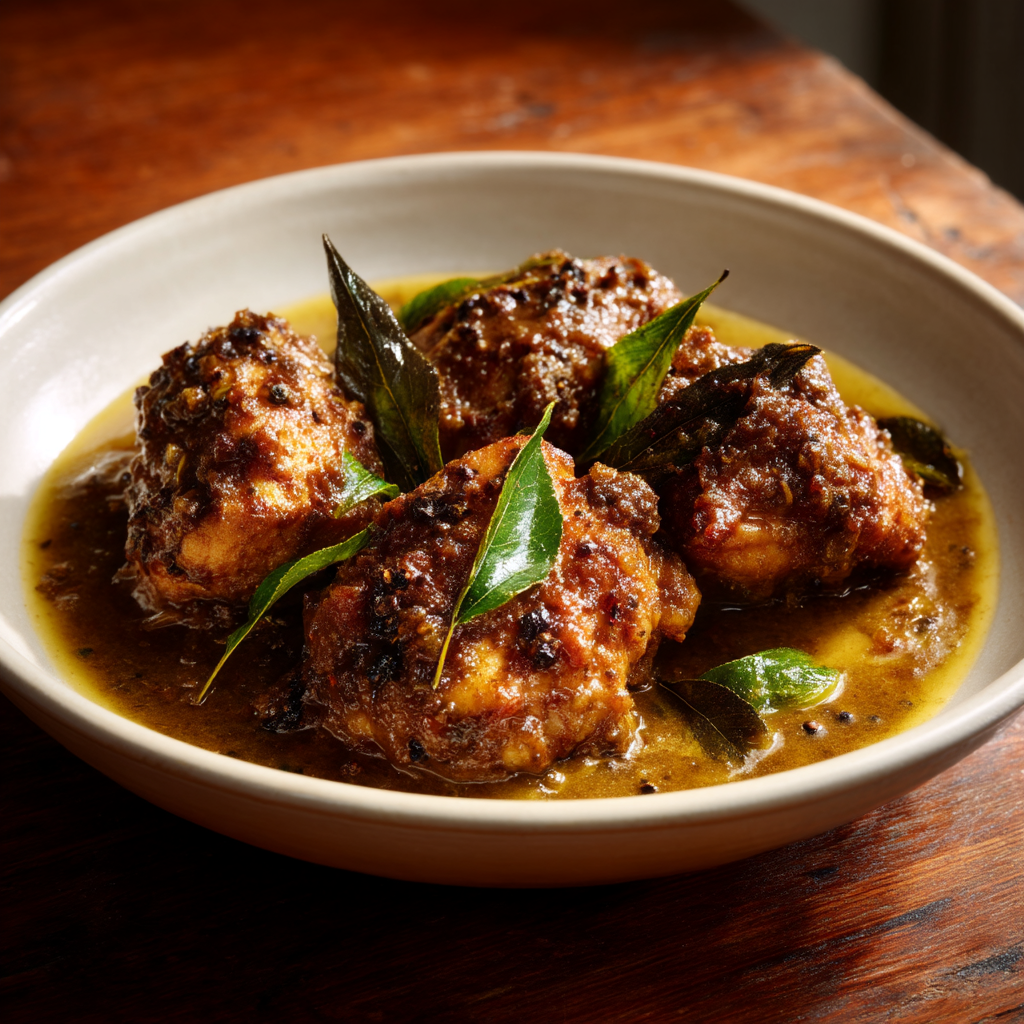
South Indian Pepper Chicken Curry Braised
Recipe Overview
Dish Name: South Indian Pepper Chicken Curry with Curry Leaves and Coconut, finished with a crackled pepper temper
Cuisine: South Indian | Category: Poultry Course | Serves: 4
Prep Time: 25 minutes | Cook Time: 45 minutes | Total Time: 1 hour 10 minutes
Why This Works
Rain hits the window, the house cools down, and your brain wants food that feels like a blanket but still tastes sharp. This south indian pepper chicken curry does exactly that. The backbone is proper South Indian method: curry leaves, toasted spices, onion-tomato base, and coconut milk treated gently so it stays silky instead of splitting. The upgrade is the pepper strategy. Pepper is layered in three stages so you get warmth and aroma, not bitterness. Cracked pepper goes in early for depth, ground pepper blooms late for perfume, and a final pepper temper in hot fat gives you that nose-opening hit right before serving. This is a curry leaves chicken curry with a coconut milk chicken curry body and a black pepper chicken curry edge, built for rice and for weather that demands something substantial.
Ingredients (Serves 4)
Chicken and quick marinade
- 800g chicken thighs, boneless skinless, cut into large bite-size pieces
- 1 tsp fine salt
- 1 tsp ground turmeric
- 2 tsp freshly ground black pepper
- 2 tsp lemon juice
Spice backbone
- 2 tbsp coriander seeds
- 1 1/2 tsp fennel seeds
- 1 tsp cumin seeds
- 6 green cardamom pods, lightly crushed
- 1 small cinnamon stick (about 5 cm)
- 6 whole cloves
- 12 fresh curry leaves (plus more for finishing)
- 2 dried red chillies (optional, background heat only)
Gravy base
- 3 tbsp neutral oil
- 1 tbsp ghee (optional but recommended)
- 2 large onions, finely sliced
- 12g ginger, finely grated
- 20g garlic, finely grated
- 2 medium tomatoes, grated or finely chopped (about 250g)
- 1 tbsp tomato paste (optional, for depth)
- 1 tsp jaggery or brown sugar
- 1 1/2 tsp fine salt, plus more to taste
- 250ml thin coconut milk (or coconut milk diluted 1:1 with water)
- 250ml thick coconut milk
- 1 tbsp tamarind pulp (or 2 tsp tamarind concentrate diluted in 2 tbsp warm water)
- Up to 200ml water, as needed
Crackled pepper temper (critical finish)
- 1 1/2 tbsp ghee or neutral oil
- 10 curry leaves
- 1 tbsp coarsely cracked black pepper
- 1/4 tsp ground black pepper
- 1 pinch salt
To serve
- Steamed rice, appam, or flaky paratha
- Lime wedges
- Fresh coriander leaves (optional)
Alt Text (hero image): south indian pepper chicken curry served with rice on a rainy day
Method
Mise en place (25 minutes)
Heavy pot or Dutch oven, small dry pan, spice grinder or mortar, microplane, wooden spoon, instant-read thermometer. Slice onions, grate ginger and garlic, prep tomatoes, pull curry leaves. The heavy pot matters because it holds heat so onions brown evenly and the masala doesn’t scorch when it tightens.
Marinate the chicken (5 minutes)
Toss chicken with salt, turmeric, ground pepper, and lemon juice. This is seasoning, not superstition. You’re setting the baseline so the curry tastes integrated, not like pepper was added as an afterthought.
Toast and grind the spices (8 minutes)
Dry-toast coriander, fennel, cumin, cardamom, cinnamon, cloves, and optional dried chillies until fragrant and just starting to darken. Cool 2 minutes. Grind to a coarse powder. Coarse keeps it aromatic and avoids that dusty bitterness fine powder can develop in a long simmer.
Build the masala base (18 minutes)
Heat oil and ghee. Add onions with a pinch of salt and cook until deep golden. Add ginger and garlic; cook 60 to 90 seconds until the raw edge is gone. Add curry leaves; stir until fragrant. Add tomatoes and tomato paste, then cook until the masala darkens and the oil starts to separate. Stir in jaggery.
Bloom spices, then sear the chicken lightly (7 minutes)
Add the ground spice mix and stir 30 seconds. Add chicken and turn to coat. Cook 3 to 4 minutes until the surface loses its raw sheen. You’re not “sealing juices.” You’re building flavour and binding spices to meat.
Coconut handling for coconut milk chicken curry texture (12 minutes)
Add thin coconut milk first. Simmer gently 5 minutes. Add tamarind and 100ml water; simmer another 5 minutes. Then add thick coconut milk, drop heat, and keep it at a quiet simmer. Boiling coconut milk is how you split it and wreck the texture.
Braise to a South Indian chicken gravy (15 minutes)
Simmer uncovered until chicken is cooked through and gravy coats a spoon. Add water in small amounts if it tightens too far. Chicken must reach 74°C in the thickest piece.
Make the crackled pepper temper (4 minutes)
Heat ghee or oil in a small pan. Add curry leaves and let them crackle hard. Add cracked pepper and stir 15 seconds. Kill heat, add ground pepper and a pinch of salt, then pour straight over the curry. This is the move that makes the whole thing smell alive.
Final balance and rest (3 minutes)
Taste and correct salt. If it tastes heavy, squeeze in lime. Rest 2 minutes before serving so the temper settles into the surface instead of evaporating into steam.
What You Need to Know
What is South Indian pepper chicken curry in this version?
Pepper-forward curry leaves chicken curry built like a proper South Indian chicken gravy, with coconut milk for body and a late pepper temper for aroma. The point is layered pepper, not raw heat.
How to make pepper chicken curry with curry leaves without bitterness
Toast spices only to fragrance, not dark brown. Use cracked pepper for warmth. Keep ground pepper mostly for the end. Ground pepper cooked hard for too long turns harsh.
Why is my pepper chicken curry bitter
Scorched masala, over-toasted spices, or too much finely ground pepper cooked too long. Fix it with a splash of thick coconut milk, a pinch of jaggery, and a squeeze of lime. Then stop cooking it.
Make-ahead: The curry base improves overnight. The pepper temper does not. Reheat the curry gently, then do a fresh temper right before serving.
The Result
You want gravy that clings to chicken and rice: not soup, not paste. First bite should hit curry leaf perfume, coconut richness, pepper warmth, then a tamarind lift that keeps it from feeling oily. When you nail it, the pepper is loud but not harsh, and the coconut reads silky, not split.
Nutrition Information (Per Serving, 2,000 Calorie Diet)
These values are estimates and will vary by coconut milk brand, chicken fat content, and exact oil use.
| Nutrient | Amount | % Daily Value |
|---|---|---|
| Calories | ~560 kcal | 28% |
| Protein | ~36 g | 72% |
| Total Fat | ~40 g | 51% |
| Saturated Fat | ~22 g | 110% |
| Carbohydrates | ~14 g | 5% |
| Fiber | ~3 g | 11% |
| Sugars | ~6 g | 12% |
| Sodium | ~950 mg | 41% |
| Cholesterol | ~170 mg | 57% |
| Potassium | ~750 mg | 16% |
Flavor Balance
Sweet (3/10): onions, jaggery rounding edges
Salty (6/10): baseline seasoning plus final correction
Sour (4/10): tamarind depth, lime sharpened finish
Bitter (1/10): controlled toast and gentle simmer keep it low
Umami (6/10): browned onion-tomato base, chicken, spice bloom
Wine Pairing (Australia)
1. Technical match
- Weight: medium-full dish, choose medium body wine with lift
- Acid balance: coconut richness needs high acid to clean the palate
- Tannin interaction: low tannin only, pepper plus tannin gets ugly
- Serving temperature: whites 8 to 10°C, light reds 13 to 15°C
2. Flavor architecture
- Primary bridge: pepper and curry leaf aromatics love citrus and floral tones
- Complementary elements: ripe fruit or a hint of residual sugar calms heat and flatters coconut
- Regional logic: Australian aromatic whites are built for spice
- Common mistakes: big oaky Chardonnay, heavy Shiraz, or anything tannic
3. Recommendations with scoring
Primary pairing: Clare Valley or Eden Valley Riesling
- Intensity match: 9/10
- Flavor harmony: 9/10
- Texture interaction: 8/10
- Why: high acid cuts coconut, citrus and florals echo curry leaves, clean finish keeps pepper feeling crisp
- Producers: Grosset, Pewsey Vale, Leo Buring
Alternative 1: Adelaide Hills or Tasmanian Gewürztraminer (dry to off-dry)
- Intensity match: 8/10
- Flavor harmony: 8/10
- Texture interaction: 8/10
- Why: aromatic punch stands up to spice, fruit lifts pepper heat without fighting it
- Producers: Henschke, Josef Chromy, Delamere
Alternative 2: Yarra Valley, Mornington, or Tasmanian Pinot Noir, slightly chilled
- Intensity match: 7/10
- Flavor harmony: 8/10
- Texture interaction: 7/10
- Why: low tannin red fruit works with savoury masala if you keep it cool and fresh
- Producers: Giant Steps, Ten Minutes by Tractor, Tolpuddle
HACCP-Compliant Storage and Safety
Cooking and holding
- Cook chicken to 74°C in the thickest piece.
- If holding hot, keep curry at 60°C or above.
- Do not leave food between 5°C and 60°C for more than 2 hours total.
Cooling
- Cool from 60°C to 21°C within 2 hours, then 21°C to 5°C within the next 4 hours.
- Portion into shallow containers to speed cooling.
Refrigeration
- Store at 5°C or below for up to 3 days.
- Store rice separately for faster, safer cooling.
Freezing
- Freeze at -18°C for up to 3 months.
- Thaw in the fridge at 5°C or below overnight.
Reheating
- Reheat to 75°C throughout.
- Reheat gently to protect coconut texture, then do a fresh pepper temper before serving.
Disposal
- Discard if held in the danger zone for more than 2 hours.
- Discard if it smells off, shows gas bubbles in storage, or is beyond recommended storage times.
