


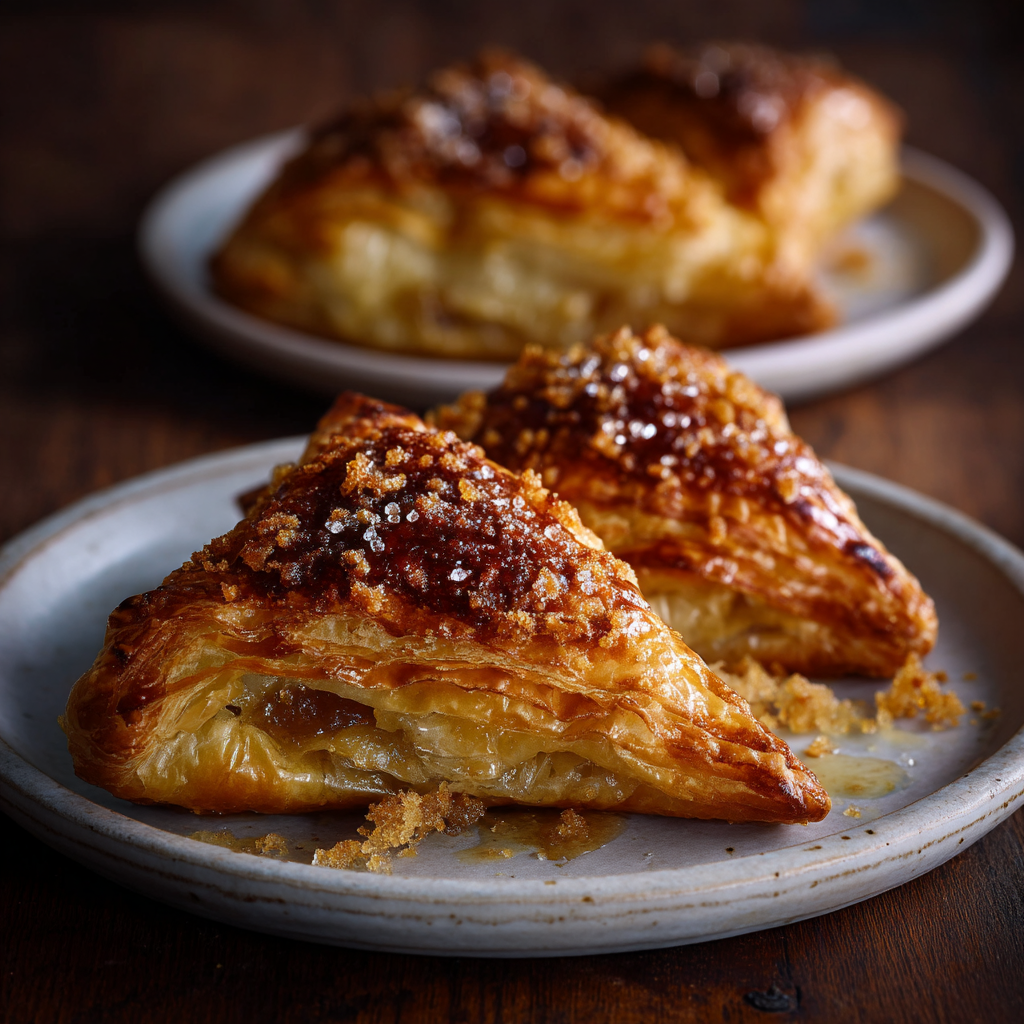
French Afternoon Tea Pastry: Honey-Poached Pear Feuilleté with Lavender Cream
Recipe Overview
Dish Name: Honey-Poached Pear Feuilleté with Lavender Cream Cuisine: French | Category: Baked Goods/Pastries | Serves: 4 Prep Time: 45 minutes | Cook Time: 55 minutes | Total Time: 1 hour 40 minutes
Why This Works
This French afternoon tea pastry combines classic pâte feuilletée technique with an unexpected filling strategy: honey-poached pears folded into lavender-infused crème pâtissière, then baked in individual squares that puff around the filling. Instead of assembling after baking like traditional French pastries, we’re employing a contained lamination approach where the custard sets during baking, creating structural integrity without sogginess. The lavender brings floral complexity without overpowering, while the honey-poached pears add textural contrast and prevent the one-dimensional sweetness you get from raw fruit. This isn’t a mille-feuille, not a chausson aux pommes, not anything with an established name because it doesn’t exist yet. It’s designed specifically for afternoon tea service, elegant enough to impress but engineered to be eaten by hand without structural collapse.
Ingredients (Serves 4)
For the Honey-Poached Pears:
- 2 firm Bosc pears (about 350g total), peeled, cored, cut into 1cm dice
- 80ml water
- 60g acacia honey
- 1 strip lemon zest (5cm length)
- 1 star anise pod
For the Lavender Crème Pâtissière:
- 250ml whole milk
- 1.5g dried culinary lavender (about 1 teaspoon, not potpourri lavender)
- 3 large egg yolks
- 50g caster sugar
- 20g cornstarch
- 15g unsalted butter, cold
- Pinch of fine sea salt
For the Pâte Feuilletée:
- 320g all-purpose flour, plus extra for dusting
- 8g fine sea salt
- 180ml cold water
- 220g unsalted butter, European-style (82% butterfat minimum), cold but pliable
For Assembly:
- 1 egg, beaten with 1 tablespoon water (egg wash)
- 20g raw sugar for finishing
Method
Mise en Place (15 minutes)
Gather all ingredients and equipment: two baking sheets, parchment paper, rolling pin, sharp knife or pizza cutter, medium saucepan, whisk, fine-mesh strainer, and plastic wrap. Cube the butter for the pâte feuilletée and return to refrigerator. Prepare an ice bath for rapid cooling of the crème pâtissière. Everything cold stays cold, everything hot gets cooled fast. This prevents bacterial growth and maintains texture integrity.
Poach the Pears (20 minutes)
Combine water, honey, lemon zest, and star anise in a medium saucepan over medium heat. Bring to a gentle simmer, add diced pears, reduce heat to low. Poach for 12-15 minutes until pears are tender but still hold their shape when pierced with a knife. They should yield with slight resistance, not turn to mush. Drain thoroughly in a strainer, discard poaching liquid and aromatics. Spread pears on a plate to cool completely. Excess moisture is your enemy here; wet fruit creates steam pockets that destroy lamination.
Make the Lavender Crème Pâtissière (15 minutes)
Heat milk with lavender in a saucepan over medium heat until it reaches 80°C (just below simmering). Remove from heat, cover, steep for 10 minutes. Meanwhile, whisk egg yolks, sugar, cornstarch, and salt in a bowl until pale and smooth. Strain the lavender-infused milk through a fine-mesh strainer directly into the egg mixture while whisking constantly. Return everything to the saucepan over medium heat. Whisk continuously until the mixture thickens dramatically and reaches 85°C, about 3-4 minutes. It should coat the back of a spoon and hold a line when you draw your finger through it. Remove from heat, whisk in cold butter until fully incorporated. Transfer to a shallow container, press plastic wrap directly onto the surface, place in ice bath to cool rapidly to below 4°C within 30 minutes. This is HACCP-critical: slow cooling breeds bacteria.
Prepare the Pâte Feuilletée (45 minutes including rest time)
Mix flour and salt in a large bowl. Add cold water, mix with your hands until a shaggy dough forms. Knead briefly on a lightly floured surface until smooth, about 2 minutes. Wrap in plastic, refrigerate for 20 minutes. Meanwhile, place cold butter between two sheets of parchment paper and beat with a rolling pin to flatten into a 12cm square. The butter should be pliable but still cold, about 15°C. Roll the dough into a 20cm square. Place the butter square diagonally in the center, fold the four corners of dough over the butter to enclose completely, pinching seams. Roll this package into a 40cm x 20cm rectangle, working quickly to prevent butter from melting. Fold into thirds like a business letter (this is your first turn). Rotate 90 degrees, roll out again to 40cm x 20cm, fold into thirds (second turn). Wrap tightly, refrigerate for 30 minutes. This creates layers; melted butter destroys them.
Complete the Lamination and Cut (15 minutes)
Remove dough from refrigerator. Give it two more turns (roll, fold, rotate, roll, fold), for a total of four turns. After the fourth turn, roll the dough into a 32cm x 32cm square, about 3mm thick. Using a sharp knife or pizza cutter, trim edges to create clean sides, then cut into four 15cm x 15cm squares. You’ll have scraps; save them for another use but don’t try to re-roll for this recipe. Place squares on a parchment-lined baking sheet, refrigerate for 15 minutes while you preheat the oven to 200°C (400°F) with a rack in the center position.
Assemble the Feuilletés (10 minutes)
Fold the cooled diced pears into the chilled lavender crème pâtissière. Place each pastry square on your work surface. Spoon about 80g of the pear-cream mixture into the center of each square, leaving a 2cm border. Brush the borders with egg wash. Fold one corner to the opposite corner, creating a triangle, and press edges firmly to seal. Use a fork to crimp the sealed edges for additional security and visual texture. Transfer to a parchment-lined baking sheet, spacing them 5cm apart. Brush the tops generously with egg wash, avoiding the cut edges (egg wash on edges glues layers together and prevents rise). Sprinkle each with 5g raw sugar. Cut three small steam vents on top of each triangle with a sharp knife.
Bake (25 minutes)
Bake at 200°C for 15 minutes until the pastries begin to puff and turn golden. Reduce temperature to 180°C (355°F) and continue baking for 10 minutes until deeply golden brown and fully puffed. The internal temperature should reach 88°C to ensure the custard is fully set and safe. Resist the urge to open the oven during the first 15 minutes; temperature fluctuation deflates pastry. Transfer to a wire rack immediately. Let cool for 10 minutes before serving. These are best consumed within 2 hours of baking while the pastry maintains its crisp-tender contrast.
What You Need to Know
The lavender must be culinary grade, not decorative. Potpourri lavender is treated with chemicals and will ruin your custard. If you can’t source it, substitute with 2 teaspoons of orange blossom water added after cooking the custard.
Butter temperature is everything in pâte feuilletée. Too cold and it shatters, breaking through the dough. Too warm and it melts into the layers. You want it bendable but still firm, like cold clay. If your kitchen is above 22°C, work quickly and refrigerate between turns.
The crème pâtissière must be completely cold before assembly. Warm custard creates steam during baking, which destroys lamination and creates soggy centers. If you’re short on time, spread it thin on a cold baking sheet and refrigerate; it’ll cool in 15 minutes.
Don’t overfill these. More filling seems generous but it creates structural failure. The 80g per pastry is calibrated to the dough’s capacity. Excess filling leaks, burns on the pan, and glues the layers together.
The Result
You get a pastry that shatters on first bite, releasing steam and the scent of honey and lavender. The exterior is deeply caramelized from the raw sugar, providing textural crunch and bitter-sweet complexity. Inside, the lavender cream is silky and floral without perfume-like intensity, while the pear pieces offer resistance and concentrated sweetness from their honey poach. The lamination creates audible crackle. Each triangle stands upright without support, holds together when lifted, and doesn’t leave your fingers greasy. The bottom stays crisp because the cold, set custard prevented steam penetration during baking. This is the textural profile afternoon tea demands: elegant, complex, hand-held without mess.
Nutrition Information Based on a 2,000 Calorie Diet (Per Serving)
| Nutrient | Amount | % Daily Value |
|---|---|---|
| Calories | 625 kcal | 31% |
| Total Fat | 38g | 49% |
| Saturated Fat | 23g | 115% |
| Trans Fat | 0g | 0% |
| Cholesterol | 245mg | 82% |
| Sodium | 485mg | 21% |
| Total Carbohydrates | 62g | 23% |
| Dietary Fiber | 3g | 11% |
| Total Sugars | 26g | – |
| Protein | 9g | 18% |
| Vitamin D | 1.2mcg | 6% |
| Calcium | 95mg | 7% |
| Iron | 2.8mg | 16% |
| Potassium | 215mg | 5% |
Flavor Balance
Sweet (7/10): Honey-poached pears and acacia honey provide rounded, floral sweetness. Raw sugar adds caramel notes. Lactose in milk and butter contribute subtle background sweetness. This is a dessert pastry, so sweetness leads but doesn’t dominate.
Salty (3/10): Fine sea salt in both the pastry dough and crème pâtissière provides structure and enhances sweetness through contrast. The salted butter adds mineral complexity. Salt here is a supporting role, amplifying other flavors rather than asserting its own presence.
Sour (2/10): Minimal presence from lemon zest in the poaching liquid, which brightens the pear flavor without adding overt acidity. The slight tang from egg yolks provides background complexity. This isn’t a tart; sourness is a balancing whisper.
Bitter (4/10): Caramelization of raw sugar and browning of butter in the pastry create pleasant bitter notes that cut richness. Lavender contributes subtle herbal bitterness that prevents cloying sweetness. The Maillard reaction on the pastry exterior adds toasted, nutty bitterness.
Umami (2/10): Butter provides glutamates, egg yolks add savory depth. This isn’t an umami-forward dish, but these elements prevent it from being one-dimensionally sweet and add a savory undercurrent that makes it suitable for afternoon tea rather than dessert service.
Wine Pairing
1. Technical Match
Weight: This pastry is medium-bodied despite its richness. The laminated dough is light and airy, the custard is silky but not heavy, and the pears add freshness. You need a wine with medium body and moderate alcohol (11-13% ABV) to avoid overwhelming the delicate floral notes or being crushed by the butter.
Acid Balance: The dish has low acidity (2/10 sour), which means the wine must provide the acid structure. Without sufficient acidity, the combination becomes heavy and cloying. Look for wines with bright acidity (6-8/10 on a wine acidity scale) to cut through the butter and refresh the palate between bites.
Tannin Interaction: Minimal tannin is required here. The pastry has fat from butter but no protein to soften aggressive tannins. Heavy tannins would clash with the sweet elements and create astringency. If pairing a red, look for soft, resolved tannins. Whites and gentle sparklings work better structurally.
Serving Temperature: Serve whites at 8-10°C, sparklings at 6-8°C. Proper chilling is critical; warmer temperatures amplify alcohol and reduce the refreshing contrast needed against butter and custard.
2. Flavor Architecture
Primary Bridge: Honey and floral aromatics. Both the poached pears and lavender share aromatic compounds (linalool, geraniol) with certain Australian white varieties, particularly Riesling and Gewürztraminer-influenced blends. The honey’s caramel notes bridge to wine’s residual sugar or barrel-aged character.
Complementary Elements: The wine’s acidity contrasts the richness while its fruit notes (stone fruit, citrus) complement the pears. Floral wine aromatics harmonize with lavender without redundancy because wine florals are typically rose and jasmine, while culinary lavender is more herbal-floral.
Regional Logic: French afternoon tea pastries traditionally pair with Champagne or Loire Valley whites. We’re translating this logic to Australia, where cool-climate sparklings and aromatic whites replicate these profiles with their own terroir signatures.
Common Mistakes: Avoid high-alcohol reds (Shiraz, Cabernet), which overwhelm delicate flavors and clash with sweetness. Skip bone-dry wines without fruit character; they taste thin and sour against honey. Avoid heavily oaked wines; they compete with butter rather than complement it.
3. Recommendations with Scoring
Primary Pairing: Late Harvest Riesling (Clare Valley or Eden Valley)
Intensity Match: 8/10 Flavor Harmony: 9/10 Texture Interaction: 8/10
Why: Late harvest Riesling from Australia’s high-altitude regions delivers the perfect technical and flavor match. The residual sugar (60-80g/L) matches the pastry’s sweetness level without being heavier, following the rule that wine should be as sweet or sweeter than the food. Clare and Eden Valley Rieslings have piercing acidity (7.5-8.5g/L) that slices through butter and custard, preventing palate fatigue. The flavor architecture is ideal: honey notes in the wine mirror your honey-poached pears, while the wine’s stone fruit character (apricot, peach) complements without duplicating the pear. These Rieslings often show floral notes (orange blossom, honeysuckle) that harmonize with lavender’s herbal florality. The light body (11-12% ABV) won’t overpower delicate pastry layers.
Specific Producers: Grosset Polish Hill, Pewsey Vale Vineyard, Jim Barry Lodge Hill
Alternative 1: Sparkling Chardonnay Pinot Noir (Tasmania)
Intensity Match: 7/10 Flavor Harmony: 8/10 Texture Interaction: 9/10
Why: Tasmanian sparkling wines, made in the traditional method, provide textural brilliance. The fine bubbles scrub butter fat from your palate, while the wine’s autolytic character (brioche, butter) creates a complementary richness that doesn’t add weight. Look for Brut or Extra Brut styles with 8-12g/L dosage to provide a hint of sweetness without competing. The high acidity (7-8g/L) provides the essential contrast, while Chardonnay’s orchard fruit notes (apple, pear) echo the poached pears. The carbonation also lifts the lavender aromatics from the custard. This is closer to the classic French afternoon tea pairing model (Champagne with pastries) but with Australian terroir expression: slightly riper fruit, more pronounced autolysis, creamier mousse.
Specific Producers: House of Arras, Jansz Tasmania, Apogee
Alternative 2: Moscato d’Asti Style (King Valley, Victoria)
Intensity Match: 6/10 Flavor Harmony: 7/10 Texture Interaction: 7/10
Why: King Valley produces Moscato in the lightly sparkling, low-alcohol Italian style that works beautifully with afternoon tea pastries. At 5-6% ABV and 100-120g/L residual sugar, these wines won’t overpower or create alcohol heat. The gentle fizz provides textural contrast without aggressive bubbles, while pronounced floral aromatics (rose, orange blossom) harmonize with lavender. Moscato’s signature grape sweetness and stone fruit flavors complement honey and pear without adding complexity or competing elements. This is the safest pairing for those who find dry wines too austere with pastries. The trade-off is less sophistication; Moscato is straightforward and fruit-forward rather than layered and complex.
Specific Producers: Pizzini, Dal Zotto, Brown Brothers
HACCP-Compliant Storage and Safety
Cooling Protocols
- Cool crème pâtissière from 85°C to 4°C within 30 minutes using an ice bath, stirring every 5 minutes to ensure even cooling
- Baked feuilletés must cool on a wire rack to room temperature (21°C) within 1 hour to prevent condensation and bacterial growth
Refrigeration Guidelines
- Store unbaked assembled feuilletés covered with plastic wrap in refrigerator at 2-4°C for maximum 4 hours before baking
- Store leftover crème pâtissière in airtight container at 2-4°C for maximum 2 days
- Do not refrigerate baked feuilletés; moisture from refrigeration destroys pastry texture and creates food safety risks from condensation
Freezing Guidelines
- Freeze unbaked assembled feuilletés on a baking sheet until solid (2 hours), then transfer to freezer bags at -18°C for maximum 1 month
- Bake directly from frozen, adding 5 minutes to baking time
- Do not freeze baked feuilletés; texture deteriorates irreversibly
- Do not freeze crème pâtissière; it separates and becomes grainy upon thawing
Maximum Holding Times
- Baked feuilletés at room temperature (18-21°C): consume within 2 hours for optimal texture and safety
- Honey-poached pears in refrigerator (2-4°C): maximum 3 days in airtight container
- Raw pâte feuilletée in refrigerator (2-4°C): maximum 2 days wrapped tightly
- Raw pâte feuilletée in freezer (-18°C): maximum 2 months
Reheating Procedures
- Reheat baked feuilletés in preheated 160°C oven for 5-7 minutes until internal temperature reaches 74°C
- Do not microwave; this creates steam that destroys lamination and creates soggy texture
- Consume reheated feuilletés immediately; do not reheat more than once
Disposal Guidance
- Discard baked feuilletés held at room temperature longer than 2 hours
- Discard any crème pâtissière that has been at room temperature longer than 1 hour
- Discard any products showing signs of mold, off-odors, or unusual texture changes
- Discard egg wash after 24 hours of refrigeration
