


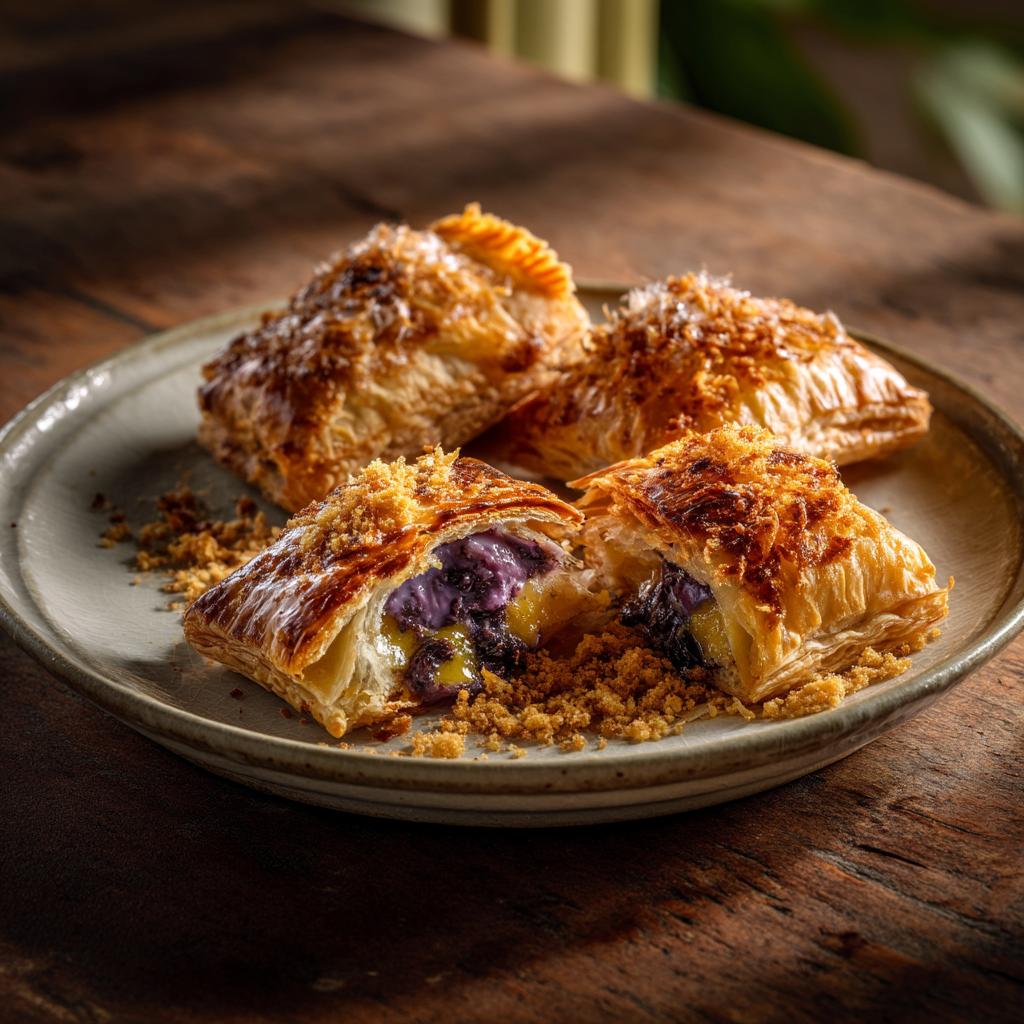
Flaky Ube-Calamansi Latik Pockets – An Original Filipino Pastry Recipe for Merienda
Recipe Overview
Dish Name: Ube-Calamansi Latik Pockets Cuisine: Filipino | Category: Baked Goods/Pastries | Serves: 4 Prep Time: 45 minutes | Cook Time: 25 minutes | Total Time: 70 minutes (plus 30 minutes chilling)
Why This Works
Filipino merienda deserves more than pandesal and ensaymada on repeat. These pastry pockets marry rough-puff lamination with intensely Filipino flavors: ube halaya’s earthy sweetness, calamansi curd’s bright acidity, and latik’s toasted-coconut crunch. The technique borrows from French viennoiserie but the soul is pure Pinoy. You get structural flakiness that actually holds a filling, not the usual bread-based vehicles. The calamansi curd cuts through ube’s starch, the latik adds textural counterpoint, and the laminated dough provides buttery scaffolding that makes sense with coconut cream. This fills a real gap in Filipino baking content: something elevated enough for afternoon tea but rooted entirely in traditional ingredients.
Ingredients (Serves 4)
For the Rough-Puff Dough:
- 250g all-purpose flour, plus extra for dusting
- 6g fine sea salt
- 180g unsalted butter, cold, cut into 1cm cubes
- 90ml ice water
- 5ml calamansi juice
For the Ube Filling:
- 200g ube halaya (purple yam jam), good quality
- 30g coconut cream, thick
- Pinch of sea salt
For the Calamansi Curd:
- 60ml fresh calamansi juice (about 12-15 calamansi)
- 50g granulated sugar
- 2 large egg yolks
- 30g unsalted butter, cubed
- Zest of 3 calamansi
For the Latik Crumble:
- 200ml coconut cream, full-fat
- 15g brown sugar
- Pinch of salt
For Assembly:
- 1 egg, beaten with 15ml water
- 20g granulated sugar for sprinkling
Method
Mise en Place (15 minutes)
Get your butter cold, truly cold. Freeze those cubes for 10 minutes before starting. Measure your ice water and add the calamansi juice. Have your rolling surface floured and ready. You’ll need a rolling pin, sharp knife or pizza cutter, pastry brush, and two lined baking sheets. Chill a metal bowl for later use with the dough.
Make the Latik Crumble (20 minutes)
Pour coconut cream into a heavy-bottomed pan over medium heat. Add brown sugar and salt. Stir constantly as it simmers and reduces. The cream will separate into oil and solids after 12-15 minutes. Keep stirring as the solids turn golden brown and crispy, about 3-4 minutes more. Drain the curds on paper towels, then crumble when cool. The coconut oil left behind is gold for other cooking, save it.
Build the Rough-Puff Dough (15 minutes active, 30 minutes chilling)
Combine flour and salt in a large bowl. Add the frozen butter cubes and toss to coat. Don’t break them down yet. Pour in the ice water-calamansi mixture and use a fork to bring it together into a shaggy mass. The butter should still be in visible chunks. Turn onto a floured surface and press into a rectangle about 20cm x 30cm. Fold into thirds like a business letter. Rotate 90 degrees, roll back to a rectangle, fold again. You’ve just done two turns. Wrap in plastic, refrigerate 30 minutes. This creates steam pockets and flaky layers without the fuss of classic puff pastry.
Prepare the Fillings (10 minutes)
Mix ube halaya with coconut cream and salt until smooth but still thick. It should hold its shape on a spoon. For the calamansi curd: whisk juice, sugar, and yolks in a small saucepan over medium-low heat. Stir constantly with a silicone spatula, scraping the bottom. After 4-5 minutes it will thicken enough to coat the back of a spoon. Remove from heat, whisk in butter and zest. Pour into a bowl and press plastic wrap directly onto the surface. Cool completely.
Roll and Cut the Dough (10 minutes)
Remove dough from refrigerator. Roll into a 30cm x 40cm rectangle on a floured surface, about 3mm thick. You want this thin enough to create layers but thick enough to hold filling. Cut into eight 10cm x 15cm rectangles. Work quickly so the butter stays cold.
Assemble the Pockets (10 minutes)
Place rectangles on your lined baking sheets. On one half of each rectangle, spread 25g ube mixture, leaving a 1cm border. Top with 1 tablespoon calamansi curd. Don’t overfill or they’ll burst. Brush edges with egg wash. Fold the empty half over the filling, press edges firmly with a fork to seal. Cut three small vents on top. Brush tops with egg wash, sprinkle with sugar. Refrigerate 15 minutes while you preheat the oven to 200°C.
Bake (25 minutes)
Bake on the middle rack for 22-25 minutes. They’re done when deeply golden brown and visibly puffed with distinct layers. The sugar should caramelize slightly. If they’re browning too fast after 15 minutes, drop temperature to 190°C. Don’t underbake or the interior layers will be doughy.
Finish and Serve (5 minutes)
Remove from oven and immediately sprinkle latik crumble over the tops while they’re hot so it adheres slightly. Let cool 10 minutes before serving. The pastry needs time to set or the filling will run. Serve warm or at room temperature.
What You Need to Know
The rough-puff technique works because you’re intentionally leaving butter in chunks that create steam pockets during baking. Don’t overwork the dough or you’ll develop too much gluten and lose tenderness. The calamansi in the dough itself adds subtle fragrance and helps tenderize through its acidity.
Ube halaya varies wildly in moisture content between brands. If yours is too wet, it will leak during baking. Cook it down in a pan for 5 minutes to evaporate excess liquid before using. The calamansi curd must be fully cooled before assembly or it will melt the butter in your dough.
These are best within 4 hours of baking but will hold at room temperature for a day. Reheat at 175°C for 5 minutes to restore some crispness. You can freeze unbaked assembled pockets for up to a month, bake from frozen adding 5 minutes to the time.
The Result
You get a pastry with actual structural integrity and visible layers, not the usual soft enriched dough. The first bite delivers butter and flake, then ube’s purple earthiness, cut immediately by calamansi’s sharp citrus. The latik provides necessary crunch and toasted coconut depth. The sugar on top caramelizes into a thin shell. This tastes expensive and intentional, which is exactly what Filipino baked goods should be delivering.
Nutrition Information Based on a 2,000 Calorie Diet (Per Serving)
| Nutrient | Amount | % Daily Value |
|---|---|---|
| Calories | 485 kcal | 24% |
| Total Fat | 31g | 40% |
| Saturated Fat | 21g | 105% |
| Trans Fat | 0g | – |
| Cholesterol | 142mg | 47% |
| Sodium | 378mg | 16% |
| Total Carbohydrates | 45g | 16% |
| Dietary Fiber | 2g | 7% |
| Total Sugars | 16g | – |
| Protein | 6g | 12% |
| Vitamin D | 0.8mcg | 4% |
| Calcium | 42mg | 3% |
| Iron | 2.1mg | 12% |
| Potassium | 285mg | 6% |
Flavor Balance
Sweet (6/10): Ube halaya provides the base sweetness with brown sugar in the latik adding caramel notes. The granulated sugar topping contributes textural sweetness through caramelization. Coconut cream brings subtle natural sweetness that rounds out the profile without pushing into dessert territory.
Salty (3/10): Sea salt in both the dough and fillings provides essential contrast to the sweet elements. Butter contributes mineral salinity that enhances the laminated layers. The salt keeps this firmly in the savory-pastry realm rather than pure confection.
Sour (7/10): Calamansi dominates the acid profile with its distinctive floral-lime character appearing in both the dough and the curd filling. This bright sourness is the critical element that prevents the pastry from becoming cloying and makes it appropriate for afternoon tea rather than dessert.
Bitter (2/10): Minimal bitter notes come from the caramelized sugar crust and the toasted elements in the latik. Ube itself has subtle earthy undertones that read as sophisticated rather than bitter.
Umami (3/10): Butter provides the primary umami through its cultured dairy compounds. The egg yolks in the curd contribute savory depth. Coconut cream adds a subtle fermented quality when reduced to latik that registers as umami complexity.
HACCP-Compliant Storage and Safety
Cooling Procedures
- Cool baked pastries to 21°C within 2 hours of removal from oven
- Do not stack pastries while cooling to prevent steam buildup and bacterial growth
- Discard any pastries left at room temperature longer than 4 hours
Refrigeration Guidelines
- Store cooled pastries in airtight containers in refrigerator at 4°C or below
- Maximum refrigerated storage: 3 days
- Keep raw dough refrigerated at 4°C, use within 48 hours
- Store prepared fillings separately at 4°C, use within 2 days
Freezing Guidelines
- Freeze unbaked assembled pastries at -18°C or below for up to 1 month
- Wrap individually in plastic wrap, then place in freezer bags
- Label with date of preparation
- Do not freeze baked pastries as texture will degrade significantly
Reheating Procedures
- Reheat refrigerated pastries to internal temperature of 74°C
- Oven method: 175°C for 8-10 minutes until center reaches temperature
- Do not reheat more than once
- Check internal temperature with probe thermometer in center of filling
Disposal Guidance
- Discard pastries with off-odors, visible mold, or signs of filling separation
- Discard any refrigerated pastries older than 3 days
- Discard frozen pastries showing freezer burn or stored longer than 1 month
- When in doubt about safety, discard immediately
