


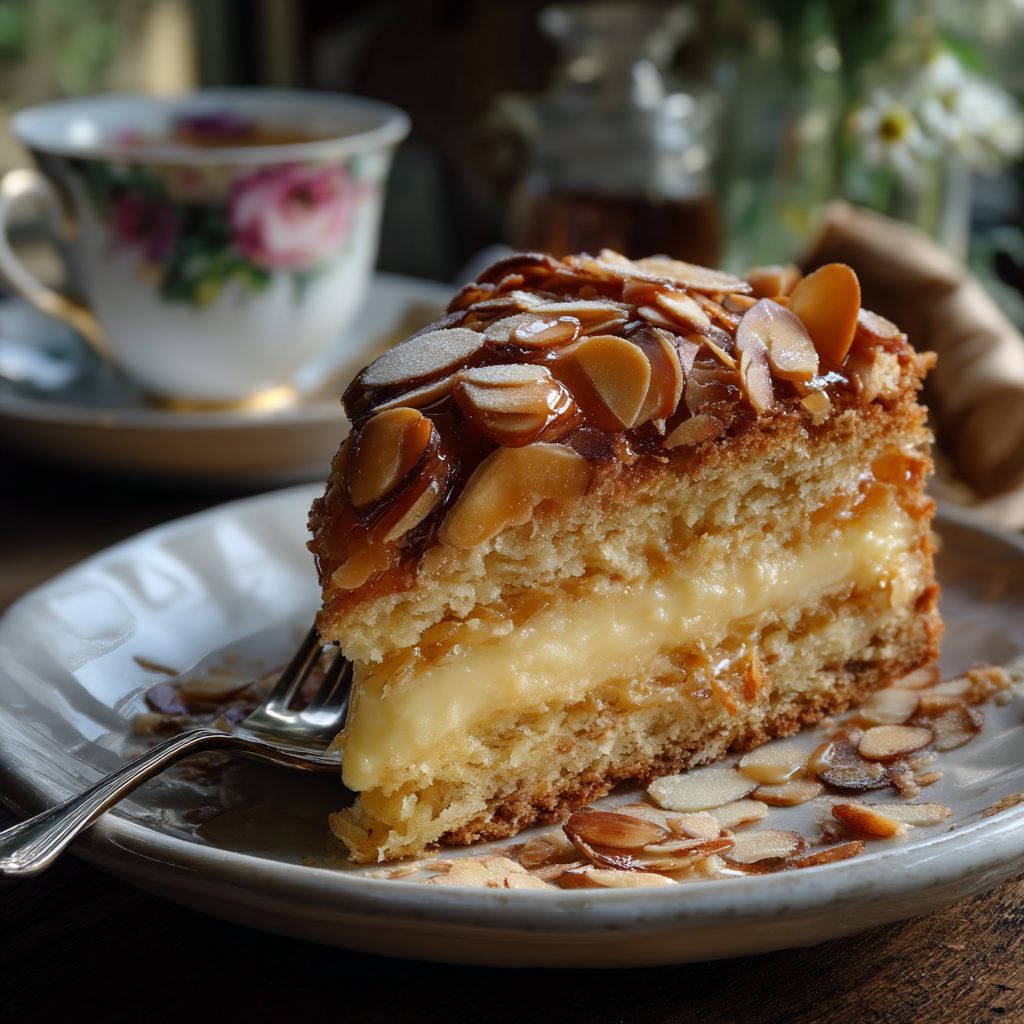
German Bienenstich: Honey-Almond Cake, Vanilla Cream, Afternoon Glory
Recipe Overview Dish Name: German Bienenstich (Bee Sting Cake) with Vanilla Custard and Caramelized Honey-Almond Topping Cuisine: German | Category: Baked Goods and Pastries | Serves: 4 Prep Time: 30 minutes | Cook Time: 25 minutes | Total Time: 2 hours 45 minutes (includes rising and cooling)
Why This Works
German Bienenstich stands as one of Germany’s most beloved afternoon tea cakes for good reason. The interplay of textures delivers what scones and Victoria sponge cannot: a buttery yeast cake with structural integrity, silky vanilla custard that doesn’t weep or separate, and a honey-almond topping that shatters with a satisfying crack before giving way to cream. This recipe streamlines the traditional Kaffee und Kuchen centerpiece without sacrificing authenticity. The yeast dough rises reliably in under two hours total. The custard sets firmly enough to slice cleanly. The caramelized topping stays crunchy for hours, not minutes. You get a sophisticated German pastry that actually works in a home kitchen, serves exactly four people for afternoon tea, and tastes like you spent all morning in a Munich bakery.
Ingredients (Serves 4)
For the Yeast Dough:
- 200g all-purpose flour, plus extra for dusting
- 7g instant yeast (one standard packet)
- 30g granulated sugar
- 3g fine sea salt
- 120ml whole milk, warmed to 40°C
- 40g unsalted butter, melted and cooled slightly
- 1 large egg, room temperature
- 5ml vanilla extract
For the Honey-Almond Topping:
- 60g unsalted butter
- 40g granulated sugar
- 30ml honey (use a robust variety like wildflower)
- 30ml heavy cream
- 100g sliced almonds
- 2g fine sea salt
For the Vanilla Custard Filling:
- 250ml whole milk
- 50g granulated sugar, divided
- 3 large egg yolks
- 20g cornstarch
- 5ml vanilla extract
- 15g unsalted butter, cold and cubed
- 100ml heavy cream, very cold
Method
Mise en Place (10 minutes)
Gather one 8-inch springform pan, parchment paper, stand mixer with dough hook and whisk attachments, medium saucepan, whisk, rubber spatula, small saucepan for topping. Bring eggs and butter to room temperature an hour ahead. Measure all ingredients precisely. The yeast dough needs warmth to rise properly, so ensure your kitchen is at least 21°C or find a warm spot near (not on) a heat source.
Prepare the Yeast Dough (15 minutes active, 60 minutes rising)
Combine flour, instant yeast, sugar, and salt in the stand mixer bowl. Whisk the warmed milk, melted butter, egg, and vanilla extract together in a separate bowl. Pour the wet ingredients into the dry and mix on low speed with the dough hook for 2 minutes until a shaggy dough forms. Increase to medium speed and knead for 8 minutes until the dough becomes smooth, elastic, and pulls away from the bowl sides. The dough should be slightly tacky but not sticky. Transfer to a lightly oiled bowl, cover with a damp towel, and let rise in a warm spot for 60 minutes until doubled.
Make the Vanilla Custard (20 minutes active, 2 hours chilling)
Heat 200ml milk with 25g sugar in a saucepan over medium heat until steaming. Whisk egg yolks with remaining 25g sugar, cornstarch, and vanilla in a bowl until pale and smooth. Slowly pour half the hot milk into the yolk mixture while whisking constantly to temper. Pour everything back into the saucepan and cook over medium heat, whisking continuously, until the custard thickens dramatically and reaches 82°C, about 3-4 minutes. Remove from heat immediately and whisk in the cold butter cubes until melted and incorporated. Pour through a fine-mesh sieve into a clean bowl, press plastic wrap directly onto the surface, and refrigerate for at least 2 hours until completely cold and set.
Prepare the Honey-Almond Topping (5 minutes)
Combine butter, sugar, honey, and cream in a small saucepan over medium heat. Stir until the butter melts and sugar dissolves completely, about 3 minutes. Remove from heat and stir in sliced almonds and salt until every almond is coated. Set aside to cool slightly. This topping will be spread on the risen dough just before baking, so timing matters here.
Shape and Second Rise (10 minutes active, 30 minutes rising)
Grease the springform pan and line the bottom with parchment. Punch down the risen dough and turn it out onto a lightly floured surface. Roll or press into an 8-inch circle, then transfer to the prepared pan. Press the dough gently to fill the pan evenly, reaching all edges. Cover with the damp towel and let rise for 30 minutes until puffy but not quite doubled. Preheat your oven to 180°C during the last 10 minutes of this rise.
Bake the Cake (25 minutes)
Spread the honey-almond topping evenly over the risen dough, working quickly but gently to avoid deflating the dough. The topping will seem like too much. It’s not. Bake for 25 minutes until the top is deep golden brown and the almonds are toasted. The cake should spring back when pressed lightly in the center. Immediately run a knife around the pan edge to prevent the caramelized topping from gluing itself to the pan. Cool in the pan for 10 minutes, then remove the springform ring and transfer to a wire rack. Cool completely before filling, about 45 minutes.
Finish the Custard Filling (5 minutes)
Whip the very cold heavy cream to stiff peaks in a clean bowl. Remove the chilled custard from the refrigerator and whisk it vigorously for 30 seconds to loosen. Fold one-third of the whipped cream into the custard to lighten it, then gently fold in the remaining cream until no white streaks remain. This lightened custard has enough structure to hold the cake layers apart without squishing out the sides.
Assemble the German Bienenstich (5 minutes)
Using a long serrated knife, carefully slice the cooled cake horizontally into two even layers. Work slowly and rotate the cake as you cut to maintain an even split. Place the bottom layer on your serving plate, cut side up. Spread the custard filling evenly across the surface, leaving a 1cm border around the edge. The filling will spread slightly when you add the top layer. Gently place the top layer, almond side up, over the custard. Press down very lightly to set. Refrigerate for 30 minutes before serving to let the custard firm up completely.
What You Need to Know
What is German Bienenstich? German Bienenstich, or Bee Sting Cake, is a traditional yeast cake with three distinct components: a tender brioche-style base, a rich vanilla custard filling, and a crunchy caramelized honey-almond topping. The name supposedly comes from a medieval German baker who was stung by a bee attracted to the honey while making this cake. The key to success lies in proper yeast activation, achieving the right custard consistency, and timing your topping application.
How to make bee sting cake successfully: The custard must reach 82°C to properly gelatinize the cornstarch, but not boil, which would cause curdling. When slicing the cake horizontally, chill it first for easier cutting, or use the dental floss method: wrap unflavored floss around the cake at the midpoint, cross the ends, and pull to cut through cleanly. The assembled cake actually improves after a few hours in the refrigerator as the flavors meld and the custard sets firmly against the cake layers.
Make-ahead strategy: Bake the cake base up to one day ahead, wrap tightly, and store at room temperature. Prepare the custard filling up to two days ahead and keep refrigerated. Assemble no more than 4 hours before serving for optimal texture contrast between the crunchy topping and soft filling. The assembled German Bienenstich holds well for up to 6 hours refrigerated, making it perfect for afternoon tea planning.
The Result
You get a cake that looks as impressive as it tastes. The honey-almond topping shatters under a fork with an audible crack, giving way to soft yeast cake that tastes faintly of butter and vanilla. The custard layer provides cool, silky contrast without being heavy or cloying. Each bite delivers textural complexity: crunch, tenderness, and cream in proper proportion. The honey provides subtle floral sweetness that complements rather than overwhelms. Slice this into quarters for four generous servings, or cut smaller wedges if serving alongside other afternoon tea items. The cake should slice cleanly without the custard squeezing out, and the topping should remain intact on each piece.
Nutrition Information Based on a 2,000 Calorie Diet (Per Serving)
| Nutrient | Amount | % Daily Value |
|---|---|---|
| Calories | 542 kcal | 27% |
| Total Fat | 31g | 48% |
| Saturated Fat | 15g | 75% |
| Trans Fat | 0g | 0% |
| Cholesterol | 186mg | 62% |
| Sodium | 312mg | 13% |
| Total Carbohydrate | 56g | 19% |
| Dietary Fiber | 3g | 12% |
| Total Sugars | 28g | – |
| Protein | 11g | 22% |
| Vitamin D | 1.2mcg | 6% |
| Calcium | 128mg | 10% |
| Iron | 2.1mg | 12% |
| Potassium | 198mg | 4% |
Flavor Balance
Sweet (7/10): Honey in the topping and sugar in the dough, custard, and almond mixture create layered sweetness. The honey adds floral complexity rather than simple sugar sweetness. Balanced enough to pair with unsweetened afternoon tea without being cloying.
Salty (3/10): Strategic salt in the dough, topping, and custard prevents one-dimensional sweetness. The salt in the almond topping particularly enhances the caramelization and makes the honey more prominent by contrast.
Sour (1/10): Minimal presence from cultured dairy in butter and slight tang in the custard from the egg yolks. Not a defining element but provides subtle brightness.
Bitter (2/10): Gentle bitterness from toasted almonds and caramelized sugar in the topping. The browned butter notes in the baked dough add mild nutty bitterness that complements the honey.
Umami (2/10): Egg yolks in the custard and dough, cultured butter, and browned proteins from baking contribute subtle savory depth. Keeps the cake from being purely sweet and one-dimensional.
HACCP-Compliant Storage and Safety
Cooling Protocol: Cool baked cake to room temperature within 2 hours of removal from oven. Once assembled with custard filling, refrigerate within 1 hour. Do not leave assembled cake at room temperature longer than 2 hours cumulative time.
Refrigeration: Store assembled German Bienenstich covered loosely with plastic wrap in refrigerator at 4°C or below. Maximum holding time is 48 hours. The custard filling contains eggs and dairy and must remain under temperature control. Check that refrigerator maintains proper temperature with a thermometer.
Freezing: Freeze only the unfilled cake base. Wrap tightly in plastic wrap, then aluminum foil. Store up to 1 month at -18°C. Thaw overnight in refrigerator before assembling. Do not freeze assembled cake as custard filling will weep and separate upon thawing, and almond topping will lose structural integrity.
Reheating: Bring refrigerated slices to room temperature for 20 minutes before serving. Do not reheat assembled cake. If the unfilled cake base seems dry, warm individual slices at 150°C for 5 minutes to refresh.
Critical Control Points: Custard must reach 82°C during cooking to ensure egg safety and proper starch gelatinization. Verify with instant-read thermometer. Discard custard if left at room temperature longer than 2 hours. Discard assembled cake if stored longer than 48 hours or if custard shows any signs of separation, off-odors, or mold.
Disposal: Discard any portions showing visible mold, off-odors, or custard separation. When in doubt about storage time or temperature exposure, discard the product. Food safety takes precedence over food waste concerns.
